


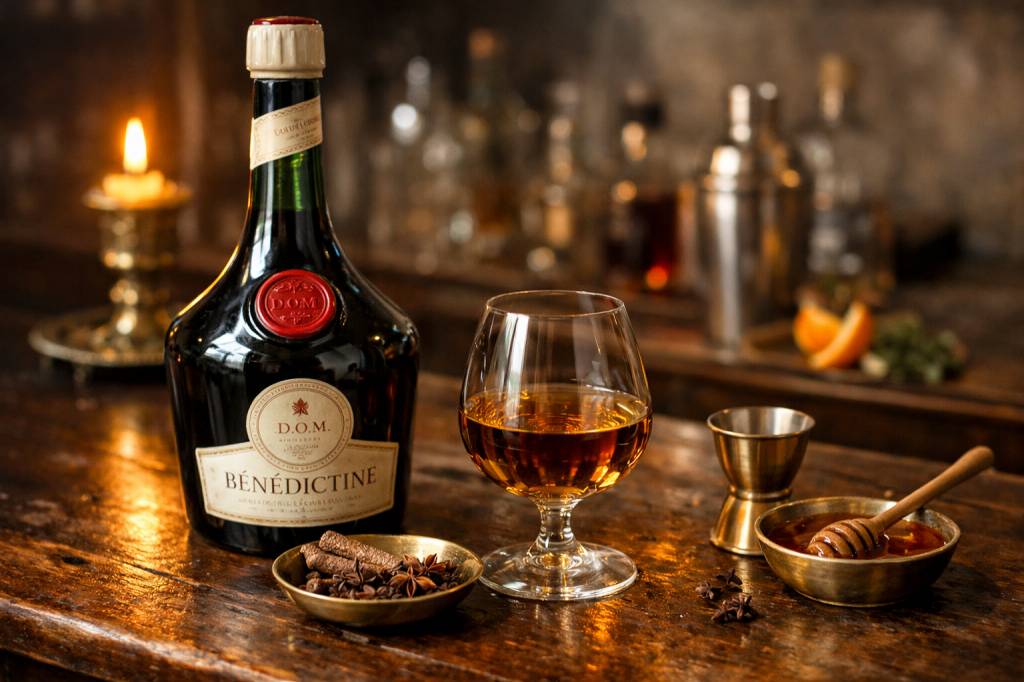
Dom Bénédictine is one of those bottles that intrigues tout le monde. The label looks a bit mysterious, the liquid is a deep golden caramel, and everyone has heard “it’s made with 27 herbs and spices”… but once the bottle is on your shelf, the big question appears: how do you actually drink it?
Let’s keep it simple: in this article, I’ll walk you through how to enjoy Dom Bénédictine neat, how to really taste it (not just “knock it back after dinner”), and how to use it in a few classic cocktails that earn it a permanent spot in your home bar.
What exactly is Dom Bénédictine?
The short version: Dom Bénédictine is a French herbal liqueur created in the 19th century in Fécamp, Normandy. It’s built on a brandy base, sweetened, and infused with a secret blend of herbs, roots and spices — officially 27 of them.
What matters more than the legend is the flavor:
- Sweetness: noticeable but not syrupy, like a rich honey.
- Herbal: thyme, sage, maybe a hint of basil — all very rounded, not bitter like a strong amaro.
- Spice: clove, nutmeg, and a soft, warming spice mix.
- Citrus: orange peel and a light lemony brightness.
- Finish: long, slightly resinous, with honey and spice lingering on the tongue.
If Chartreuse feels “too much” for you, Dom Bénédictine sits in a friendlier zone: complex and herbal, but softer, warmer, and easier to sip.
How to drink Dom Bénédictine neat
Dom Bénédictine is often treated only as a cocktail ingredient, but it’s absolutely worth tasting on its own. Here’s how to give it a fair try.
The right temperature and glass
Temperature:
- Best: lightly chilled or cool room temperature (around 14–18°C / 57–64°F).
- Avoid: serving it ice cold straight from the freezer — you’ll mute most of the aromatics.
Glassware:
- Ideal: a small tulip glass, snifter, or even a small white wine glass.
- OK: a rocks glass, if that’s what you have; just don’t fill it with ice for your first tasting.
I like to pour about 20–25 ml (¾ oz) for a first tasting. Enough to swirl, smell and sip, but not so much that you feel you have to finish the glass if you’re not sold yet.
A simple tasting ritual at home
No need to act like a sommelier, but taking two minutes to taste with intention will tell you a lot about how you’ll use Dom Bénédictine later.
- Step 1 – Look: Hold the glass to the light. Notice the deep amber / golden color and the viscosity when you tilt the glass.
- Step 2 – Smell: Gently swirl, then bring the glass to your nose. Breathe in slowly with your mouth slightly open. Try to pick up one or two things only: “herbal”, “spicy”, “honeyed”. No need for poetry.
- Step 3 – First sip: Take a tiny sip, hold it on your tongue for a few seconds, then swallow. Pay attention to the sweetness and the texture (it should feel silky, almost oily).
- Step 4 – Second sip: Now that your palate is used to the sugar, you’ll notice more detail: minty freshness, orange zest, clove, honey, maybe a touch of licorice.
If you’re new to herbal liqueurs, don’t panic if the first impression is “whoa, that’s a lot”. Let it sit a minute. Take another small sip. These flavors tend to open up as your palate adjusts.
Neat, on the rocks, or with a twist?
Once you’ve tasted it straight, you can fine-tune how you prefer it:
- Neat: Best if you want to get to know the liqueur. Ideal as a small after-dinner sip.
- On a rock: One large ice cube will slightly dilute and soften the sweetness and alcohol over a few minutes. Great if you find it a bit intense neat.
- With a citrus twist: A thin piece of orange or lemon peel expressed over the glass (spritz the oils on top) adds brightness and makes it feel less heavy.
At home, I almost never pour Bénédictine in a big glass of ice. You lose the aromatics too fast and end up just tasting sweet, cold herbal water. One big cube, or none.
Light mixers: when you want “almost neat”
If sipping neat still feels a bit strong, use a small splash of mixer to stretch it without turning it into a full cocktail.
- Bénédictine + cold water: 40 ml (1⅓ oz) Dom Bénédictine + 10–20 ml (⅓–⅔ oz) still water, stirred with ice. This opens the flavors like adding water to whisky.
- Bénédictine Highball: 40 ml (1⅓ oz) Bénédictine in a tall glass with ice + top with soda water. Garnish with a lemon wheel. Soft, herbal, refreshing, and low effort.
- Tea time twist: 25 ml (¾ oz) Bénédictine in a mug of hot black tea, with a lemon slice. Perfect winter evening trick if you love cozy drinks but don’t want to open a bottle of wine.
Classic B&B: the easiest way to start
If there’s one serve most people associate with Bénédictine, it’s the B&B: Bénédictine and brandy. This is a very gentle way to discover the liqueur.
Classic B&B (build in glass)
- 30 ml (1 oz) Dom Bénédictine
- 30 ml (1 oz) brandy or cognac
Method:
- Add both ingredients to a small snifter or rocks glass.
- Serve neat or over one large ice cube.
The brandy dries out the sweetness a little and adds depth. If you’re worried about it being too strong, you can pour a smaller portion or add a splash of water.
I like this as a “slow evening” drink: small glass, couch, maybe a book, and you sip it over 20–30 minutes. You don’t need more than that.
Dom Bénédictine in classic cocktails
Now that you know how it behaves neat, let’s move to what most of you really want: how to use Dom Bénédictine in cocktails without wasting half the bottle on failed experiments.
Good news: you don’t need to reinvent recipes. Bénédictine is already a star in several classics, often used in small quantities to add complexity.
Vieux Carré: New Orleans meets French herbs
The Vieux Carré is one of my favorite “serious” cocktails to showcase Dom Bénédictine. It’s boozy but elegant, somewhere between a Manhattan and an Old Fashioned, with a subtle herbal layer from the Bénédictine.
Vieux Carré
- 30 ml (1 oz) rye whiskey
- 30 ml (1 oz) cognac
- 30 ml (1 oz) sweet vermouth
- 7.5 ml (¼ oz) Dom Bénédictine
- 2 dashes Angostura bitters
- 2 dashes Peychaud’s bitters (optional but recommended)
Method:
- Add all ingredients to a mixing glass with ice.
- Stir for 20–25 seconds until well chilled.
- Strain into a rocks glass over a large cube, or into a chilled coupe.
- Garnish with a lemon twist or cherry.
The key here is the small amount of Bénédictine. You don’t want it to dominate; you want a gentle herbal sweetness under the rye spice and cognac richness.
Simplified Singapore Sling (Bénédictine version)
The original Singapore Sling recipe is notoriously complicated and varies a lot. Bénédictine often appears in the classic specs. Here’s a streamlined, home-friendly version that still gives you the tropical, herbal, slightly old-school vibe.
Singapore Sling (home bar version)
- 45 ml (1½ oz) gin
- 15 ml (½ oz) cherry liqueur
- 10 ml (⅓ oz) Dom Bénédictine
- 15 ml (½ oz) triple sec or orange liqueur
- 20 ml (⅔ oz) fresh lemon juice
- 60–90 ml (2–3 oz) soda water (to top)
Method:
- Add everything except soda water to a shaker with ice.
- Shake hard for 10–12 seconds.
- Strain into a tall glass filled with ice.
- Top with soda water and give a quick, gentle stir.
- Garnish with an orange slice and a cherry if you’re in the mood.
Here, Bénédictine adds depth to what could otherwise be just a sweet, fruity drink. It gives the cocktail a grown-up backbone.
Monte Carlo: an herbal twist on the Old Fashioned
If you’re comfortable making an Old Fashioned, the Monte Carlo is basically the same move, with Bénédictine instead of simple syrup.
Monte Carlo
- 60 ml (2 oz) rye whiskey (or a bold bourbon)
- 15 ml (½ oz) Dom Bénédictine
- 2 dashes Angostura bitters
Method:
- Add all ingredients to a mixing glass with ice.
- Stir until well chilled.
- Strain into a rocks glass over a large cube.
- Garnish with a lemon or orange twist.
The Bénédictine replaces syrup, bringing sweetness plus herbal complexity. If you find it too sweet at first, drop the Bénédictine down to 10 ml (⅓ oz).
Frisco: for when you’re “whisky curious”
The Frisco is a simple drink that’s very gentle for people who find straight whisky a bit aggressive. It’s basically whisky softened by Bénédictine and brightened with lemon.
Frisco
- 45 ml (1½ oz) rye or bourbon
- 15 ml (½ oz) Dom Bénédictine
- 1–2 dashes Angostura bitters (optional)
Method:
- Stir all ingredients with ice until cold.
- Strain into a chilled coupe or Nick & Nora glass.
- Garnish with a lemon twist.
This is a great “gateway” cocktail if you’re transitioning from sweeter liqueur-based drinks to spirit-forward classics. The Bénédictine softens the whisky’s edges without hiding it.
Easy modern serves with Dom Bénédictine
Once you understand that Bénédictine brings sweet, herbal, spicy, and honeyed notes, you can start treating it like a seasoning: a little goes a long way.
Here are a few low-risk ideas you can try with what’s probably already in your kitchen.
Herbal Champagne (or Prosecco) Cocktail
- 10–15 ml (⅓–½ oz) Dom Bénédictine
- Top with chilled dry sparkling wine
Method:
- Pour Bénédictine into a flute.
- Top slowly with sparkling wine.
- Garnish with a lemon twist.
This turns a basic bubbly into something more interesting, with a delicate herbal sweetness. Ideal as an aperitif for guests who like something a bit different but not too intense.
Herbal Sour (shake version)
- 45 ml (1½ oz) gin or bourbon
- 15 ml (½ oz) Dom Bénédictine
- 25 ml (¾–1 oz) fresh lemon juice (adjust to taste)
Method:
- Add all ingredients to a shaker with ice.
- Shake hard for 10 seconds.
- Strain into a rocks glass with ice.
- Garnish with a lemon wheel.
Think of this as a herbal Whiskey Sour (or Gin Sour). The Bénédictine acts as both sweetener and flavoring.
Simple Bénédictine & Tonic
- 30 ml (1 oz) Dom Bénédictine
- 90 ml (3 oz) tonic water (or to taste)
Method:
- Build over ice in a tall glass.
- Give a gentle stir.
- Garnish with a lemon or orange wedge.
This is surprisingly refreshing: bitter tonic balances the sweetness and lifts the herbal notes.
Food pairing ideas with Dom Bénédictine
Because of its honey, spice, and herbal profile, Bénédictine can pair beautifully with desserts and cheese.
- With desserts: crème brûlée, orange cake, spice cake, gingerbread, or a simple vanilla ice cream with a small drizzle (go light, it’s powerful).
- With cheese: blue cheeses (Roquefort, Stilton), aged goat cheese, or a nutty Comté. Serve a small 20 ml (⅔ oz) pour neat or on one rock.
- With dark chocolate: a square of 60–70% dark chocolate alongside a small glass neat can be a very simple but elegant end to a meal.
If you host often, this is an easy “signature move”: one small bottle of Bénédictine + a dessert platter = guests asking, “What’s in this glass, it’s delicious?”
How to store and use Dom Bénédictine in your home bar
Bénédictine is relatively low-maintenance:
- Storage: keep the bottle upright, tightly closed, away from direct sunlight and heat. A cupboard or bar cart away from the window is fine.
- Shelf life: thanks to the sugar and alcohol, it keeps well for years, though the flavors will slowly soften over time. You don’t need to rush.
- Versatility: even if you only use 7–15 ml at a time in cocktails, that’s enough to change a drink. A single bottle will fuel a lot of experiments.
Think of Bénédictine as your “secret weapon” bottle: when a cocktail feels flat or too sharp, a barspoon or two can round the edges and add warmth and complexity.
How to decide if Dom Bénédictine deserves a spot on your shelf
If you’re still on the fence, ask yourself:
- Do you enjoy sipping herbal or spiced liqueurs after dinner?
- Do you like spirit-forward cocktails (Manhattan, Old Fashioned, Sazerac) and want to explore variations?
- Do you host and want one bottle that can: be served neat, in a Champagne cocktail, and in a whisky classic?
If you answered “yes” to at least one of these, Dom Bénédictine is a good investment bottle. Start simple: taste it neat, make a B&B, then try a Monte Carlo or Vieux Carré. Once you understand what it brings to the glass, it becomes one of those “how did I ever live without this?” ingredients.